
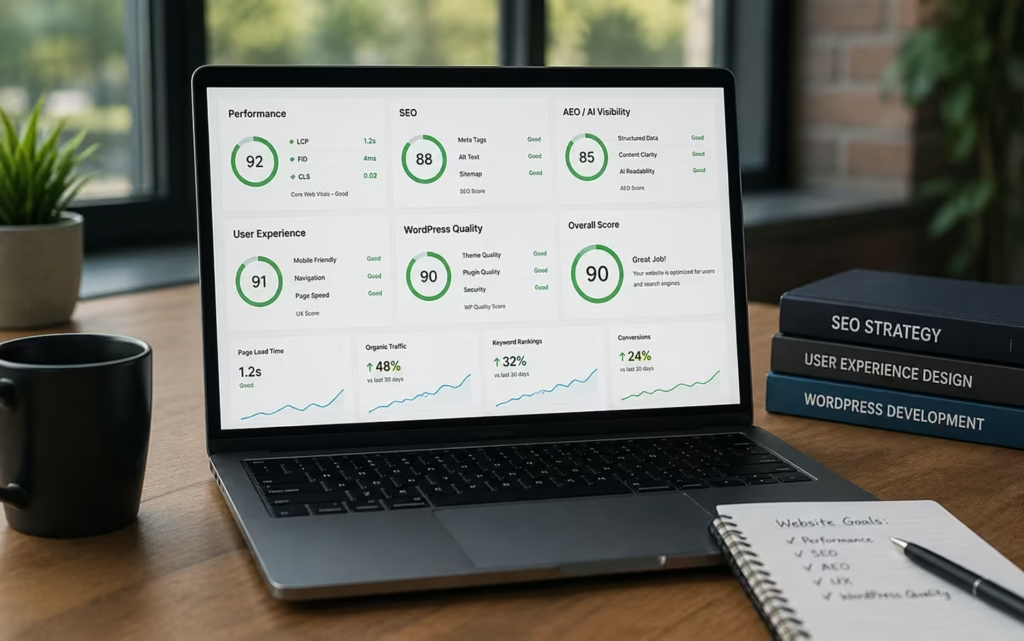
A website is no longer just a digital brochure. It is your sales engine, trust signal, lead generation system, analytics hub, and often the first serious interaction a customer has with your business.
But having a website is not enough.
If your website is slow, confusing, poorly structured, or disconnected from your marketing tools, it will quietly cost you traffic, leads, and revenue.
Today, a strong website needs to do more than look good. It must load fast, guide users clearly, support search engine visibility, answer real customer questions, connect with analytics, and work together with your marketing ecosystem.
That is where Core Web Vitals, UI/UX, page speed, SEO, AEO, custom WordPress development, Google tools, and social media integrations become critical.
Why This Matters From Real Project Experience
After working on websites across different industries, one thing becomes clear: most performance problems are not caused by one single issue.
Usually, they come from a combination of slow hosting, heavy themes, too many plugins, unclear layouts, poor mobile experience, weak SEO structure, missing analytics, and disconnected marketing tools.
A website may look finished, but if it loads slowly, feels confusing, does not rank, or cannot track user actions properly, the business is losing opportunities every day.
That is why we approach websites as complete digital systems, not just design files or WordPress pages.
A strong website needs clean development, fast performance, clear user experience, search visibility, answer-ready content, analytics, and marketing integrations working together.
What Makes a Modern Website Perform?
A modern business website should answer five important questions:
- Can users understand the offer quickly?
- Can Google crawl, index, and understand the website properly?
- Can AI and answer engines extract useful information from the content?
- Can the business track leads, clicks, forms, and conversions?
- Can the website scale as the business grows?
If the answer is no, the website needs improvement.
Core Web Vitals: The Foundation of a Healthy Website
Core Web Vitals measure how users actually experience your website.
They focus on three key areas:
Largest Contentful Paint (LCP)
This measures how quickly the main content of the page loads.
Interaction to Next Paint (INP)
This measures how quickly the website responds when users click, tap, or interact.
Cumulative Layout Shift (CLS)
This measures how stable the layout is while the page loads.
These are not just technical metrics. They affect how professional your website feels.
A slow hero section, delayed button response, or shifting layout can make visitors lose trust before they even read your offer.
A technically healthy website gives users confidence. It tells them your business is serious, modern, and reliable.
UI/UX: Design Is Not Decoration – It Is Direction
Good UI/UX is not only about making a website look beautiful. It is about helping users understand where they are, what you offer, why it matters, and what they should do next.
Strong UI/UX improves:
- First impression
- Navigation clarity
- Content readability
- Conversion flow
- Trust and credibility
- Mobile experience
- Lead generation
For business websites, every section should have a purpose.
The hero section should communicate value fast. Service pages should explain outcomes, not just features. Calls to action should be visible, specific, and easy to follow.
When UI/UX is done correctly, users do not feel lost.
They feel guided.
Page Speed: Faster Websites Convert Better
Page speed directly affects user behavior.
Visitors expect websites to load quickly, especially on mobile. If the site feels slow, many users leave before the page finishes loading.
Speed affects:
- SEO performance
- Bounce rate
- Lead generation
- Paid ads efficiency
- User trust
- Mobile conversions
For companies investing in SEO, Google Ads, social campaigns, or content marketing, a slow website weakens the entire marketing system.
You can pay for traffic, but if the website is slow, that traffic will not perform as well as it should.
A fast website improves the entire digital journey, from first click to conversion.
SEO: Visibility Starts With Structure
SEO is not only about keywords.
Modern SEO is about helping search engines understand your website, your services, your expertise, and the value you provide to users.
A strong SEO foundation includes:
- Clear page structure
- Optimized headings
- Keyword-focused content
- Internal linking
- Technical SEO
- Image optimization
- Schema markup
- Fast loading speed
- Mobile-friendly design
- Clean URLs
- Metadata optimization
- Search Console monitoring
If your website is not structured properly, Google may struggle to understand which pages are important, what your business offers, and which searches your content should appear for.
That is why SEO should be planned before development, not added after launch.
A website built with SEO from the beginning has a stronger foundation for long-term organic growth.
Why SEO Matters for Business Websites
SEO helps your website appear when people are actively searching for your services.
For example, if someone searches for:
- Custom WordPress development company
- Website performance optimization
- Core Web Vitals improvement
- UI/UX design for business websites
- SEO-ready WordPress website
- Google Analytics setup for websites
Your website should have content, structure, and technical quality that helps it compete for those searches.
Without SEO, your website may look good but remain invisible.
With SEO, your website becomes a long-term traffic and lead generation asset.
AEO: Answer Engine Optimization for AI Search
AEO stands for Answer Engine Optimization.
It focuses on making your content easier for search engines, AI assistants, and answer engines to understand, extract, and present as a useful answer.
Traditional SEO helps your website rank in search results.
AEO helps your content become clear enough to answer specific user questions.
This matters because people are no longer searching only with short keywords. They are asking complete questions such as:
Why is my WordPress website slow?
How do Core Web Vitals affect SEO?
What tools should be connected to my business website?
Why is UI/UX important for conversions?
What is the difference between SEO and AEO?
AEO helps your website respond to these kinds of questions with clear, structured, helpful answers.
How AEO Improves Website Content
AEO-friendly content is written in a way that is easy to understand, easy to scan, and easy to reuse as a direct answer.
It usually includes:
- Clear questions and answers
- Short explanations
- Structured headings
- Helpful definitions
- FAQ sections
- Schema markup
- Service-specific explanations
- Natural language content
- Expert insights
- Direct answers before deeper details
This does not replace SEO.
It strengthens it.
SEO helps users find your website. AEO helps your website become the answer.
SEO and AEO Work Best Together
SEO and AEO should not be treated separately.
A strong website needs both.
SEO focuses on search visibility.
AEO focuses on answer visibility.
UI/UX focuses on user experience.
Core Web Vitals focus on performance.
Analytics focuses on measurement.
WordPress quality focuses on scalability and control.
When all of these work together, your website becomes easier to find, easier to understand, and easier to trust.
That is the real goal.
Custom WordPress Development: Why Theme Quality Matters
WordPress is powerful, but not every WordPress website is built properly.
Many websites rely on overloaded themes, too many plugins, heavy page builders, unoptimized scripts, and poor database structure.
The result is a website that looks acceptable on the surface but performs badly underneath.
Custom WordPress development allows your website to be built around your actual business needs.
A strong custom WordPress build can improve:
- Speed and Core Web Vitals
- SEO structure
- AEO-friendly content layouts
- Security
- Scalability
- Content management
- Mobile responsiveness
- Custom layouts
- Clean code
- Plugin control
- Long-term maintenance
The goal is not just to build pages.
The goal is to build a website system that can grow with your business.
For service companies, SaaS brands, eCommerce stores, agencies, consultants, and B2B companies, this matters because your website needs to support marketing, sales, analytics, content, and future expansion.
Google Tools Connected: You Cannot Improve What You Do Not Measure
A professional website should be connected to the right Google tools from day one.
This usually includes:
- Google Analytics 4
- Google Search Console
- Google Tag Manager
- Google Business Profile
- Google PageSpeed Insights
- Conversion tracking
- Event tracking
- Form submission tracking
- Click tracking
- SEO performance monitoring
Without these tools, you are guessing.
With them, you can see:
- Which pages bring traffic
- Which keywords users search
- Which forms generate leads
- Where users drop off
- Which campaigns perform
- Which technical issues need fixing
- Which pages need SEO improvement
A connected website gives business owners visibility.
It turns the website from a static asset into a measurable growth platform.
Social Media Connected: Your Website Should Support Your Marketing Ecosystem
Your website and social media should not work separately.
They should support each other.
Social media brings attention. Your website turns that attention into trust, leads, bookings, purchases, or inquiries.
Important social media integrations may include:
- Social profile links
- Share buttons
- Meta Pixel
- LinkedIn Insight Tag
- TikTok Pixel
- Instagram feed integration
- Open Graph image setup
- Social preview optimization
- Campaign landing pages
- Retargeting audiences
When social media is properly connected, your business can track campaigns, retarget visitors, improve ad performance, and create a more consistent brand experience.
This is especially important for companies running paid campaigns.
Without tracking and integration, you may get traffic but not enough useful data to improve results.
The Real Business Impact
When all of these elements work together, your website becomes stronger across every important area.
You get a website that:
- Loads faster
- Feels more professional
- Ranks better over time
- Answers customer questions clearly
- Supports AI and answer-based search
- Converts more visitors
- Tracks real performance
- Supports paid ads
- Connects with social media
- Gives users a better experience
- Helps your business scale
A modern website is not just about design.
It is about performance, structure, experience, visibility, data, and growth.
Our Approach at Makdev
At Makdev, we build websites with performance, usability, SEO structure, AEO-ready content, and business growth in mind from the beginning.
Our process looks beyond visual design.
We review how fast the website loads, how users move through the page, how the content is structured for search engines, how clearly it answers user questions, how forms and conversions are tracked, and how the website connects with Google and social media platforms.
This allows us to create websites that are not only visually strong, but also measurable, scalable, and easier to improve over time.
For us, a successful website should answer three important questions:
Can users understand it quickly?
Can Google and AI systems understand it properly?
Can the business measure what is working?
When the answer is yes, the website becomes more than an online presence.
It becomes a real growth asset.
Conclusion
Your website should not only exist online.
It should perform, rank, answer, convert, and grow with your business.
Core Web Vitals, UI/UX, page speed, SEO, AEO, custom WordPress development, Google tools, and social media integrations are not separate improvements.
They are connected parts of one digital system.
When they work together, your website becomes faster, clearer, more visible, more measurable, and more valuable to your business.
That is what modern website development should deliver.
What is the difference between SEO and AEO?
SEO helps your website rank in search engines. AEO helps your content answer specific questions clearly so it can be understood by search engines, AI tools, and answer-based search platforms.
Why are Core Web Vitals important for my website?
Core Web Vitals measure loading performance, responsiveness, and visual stability. They help show how users experience your website and whether technical performance may be affecting trust, usability, and conversions.
Does page speed affect SEO?
Yes. A faster website improves user experience and supports stronger technical SEO. Slow websites can increase bounce rates, reduce conversions, and weaken the performance of paid and organic traffic.
Why is UI/UX important for business websites?
UI/UX helps visitors understand your offer, navigate your website, trust your brand, and take action. Good design improves the customer journey and can increase lead generation.
Is custom WordPress development better than using a ready-made theme?
For serious business websites, custom WordPress development usually gives better control, cleaner code, stronger performance, improved scalability, and a more flexible SEO structure.
Which Google tools should every business website have?
Most business websites should be connected with Google Analytics 4, Google Search Console, Google Tag Manager, Google Business Profile, and proper conversion tracking.
Why should social media be connected to my website?
Social media integrations help your website support campaigns, retargeting, tracking, content sharing, and brand consistency across platforms.
How does AEO help my website appear in AI search?
AEO helps by structuring content around clear questions, direct answers, helpful explanations, and well-organized headings. This makes it easier for AI systems and answer engines to understand and summarize your content.