
The Challenge
- Rigid platforms, disconnected systems, and generic experiences limit scalability, performance, and conversions.
GTM & Sell More
Custom e-commerce solutions that go beyond off-the-shelf limitations. We build headless storefronts, custom checkout experiences, and AI-powered personalisation that drive revenue.
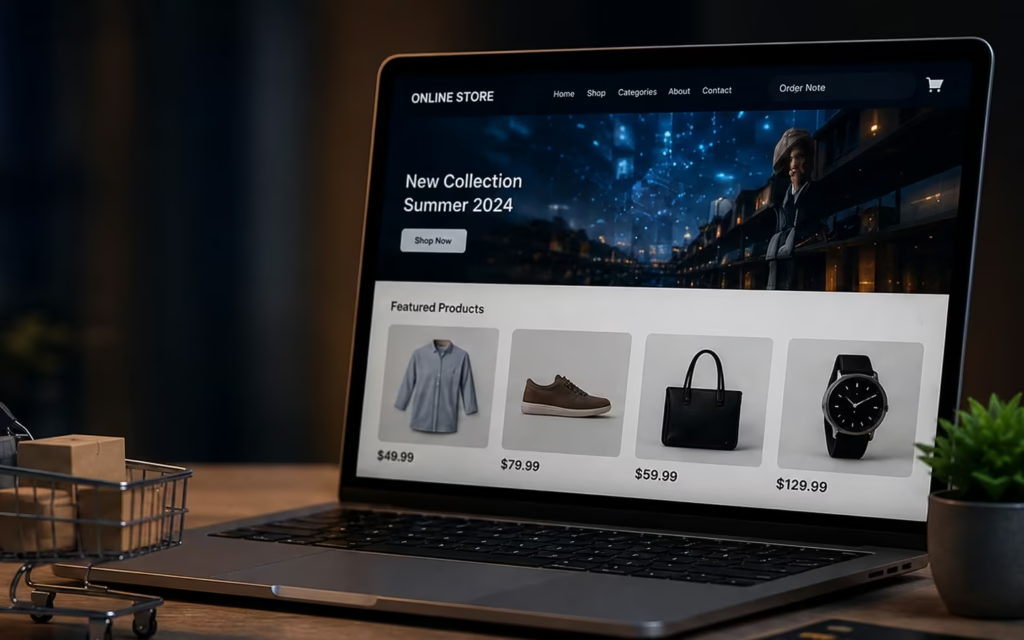
Headless commerce separates the customer-facing frontend from the backend commerce logic, connecting them via API. This gives you full control over the user experience without being constrained by what the commerce platform’s templating system supports, and it makes it possible to serve the same commerce data to a web storefront, a mobile app, and an in-store screen from a single backend.nWe build headless storefronts using Next.js for the frontend, connected to the commerce backend of your choice and a headless CMS for content management. The storefront loads fast, performs well in search rankings because the frontend is built to Core Web Vitals standards from the ground up, and can be extended and customised without the limitations of a theme-based architecture.
Every customer seeing the same storefront is a missed opportunity. Purchase patterns, browsing behaviour, category affinity, and order history contain the information needed to show each customer what they are most likely to buy. Most platforms surface only a fraction of that.nWe build personalisation and recommendation systems trained on your customer data: product recommendations on the product page and in the cart, dynamic homepage and category page ordering based on individual behaviour, cross-sell and upsell logic that reflects actual purchase patterns rather than manually curated relationships. The system improves over time as more behavioural data accumulates.
When the order management capabilities of a platform do not match how the business actually fulfils orders, custom OMS development is the answer. Multi-warehouse allocation logic, drop-shipping arrangements, pre-order handling, split shipments, click-and-collect, returns and exchanges: the standard OMS covers the standard case. The businesses we work with often have something more specific.nWe build inventory and order management systems tailored to your fulfilment model and integrate them with existing ERP, WMS, and logistics platforms. The result is order logic that reflects how your operations work rather than requiring operations to adapt to what the platform supports.
Selling internationally involves more than displaying prices in local currencies. Tax calculation by jurisdiction, local payment method preferences, currency conversion that does not erode margins, address validation by country, consumer protection requirements that vary by market, and compliance with local regulations all need to be handled correctly at the point of checkout.nWe build multi-region checkout flows that manage these requirements properly. Local payment methods, regional tax handling, currency display and conversion, jurisdiction-specific compliance, and localised checkout copy are all part of the build rather than workarounds added after the fact.
Customers do not think in channels. They browse on mobile, add to a cart on desktop, and complete a purchase in store. They buy online and return in person. They check stock availability in the app before travelling to a location.nThe data that makes these experiences coherent, inventory levels, customer purchase history, cart state, loyalty balances, needs to be consistent across every touchpoint in real time. We build the omnichannel infrastructure that connects web, mobile, and point-of-sale through a shared data layer, so customer experience is coherent regardless of where an interaction happens.
E-commerce platforms that are re-architected under traffic, mid-season, or while managing a large customer base are expensive, risky, and disruptive. The migration from a platform that has become a constraint to one that supports the next phase of growth is never as clean as it sounds.nThe businesses that scale e-commerce efficiently are the ones that made good architecture decisions before they needed to. A storefront architecture that performs under real traffic rather than demo conditions. A checkout that handles edge cases rather than breaking on them. Inventory logic that reflects the actual fulfilment operation. These decisions are significantly easier to make at the start than to fix under pressure later.
A standard platform is simpler to operate and often the right choice for businesses whose requirements fit within what it supports. Headless becomes the right answer when you need frontend performance the platform’s templating cannot achieve, complete control over the user experience, or the ability to serve the same commerce data to multiple frontends from a single backend. We will give you a direct recommendation based on your actual requirements.
Yes. Platform migrations are a significant part of what we do. We manage data migration, URL redirect strategy to protect SEO equity, parallel running periods to validate accuracy, and the cutover process to minimise downtime and risk.
Infrastructure is scaled and load tested before any peak period. For headless storefronts on modern edge infrastructure, the architecture handles significant traffic spikes as a design assumption. We establish the expected peak load during discovery and build to exceed it.
Personalisation quality improves with data volume, but useful personalisation is possible with more modest datasets than most businesses assume. We assess your available data during discovery and design the approach to fit what you have. Meaningful lift is achievable earlier in the data lifecycle than most expect.
Yes. Integration with existing ERP, WMS, and logistics platforms is standard in our commerce builds. We assess the integration requirements during discovery and design accordingly.
Yes, through our mobile app development practice. For clients who need both a web storefront and a native mobile app, we design the commerce backend to serve both from day one rather than treating the mobile app as an afterthought.
If your current setup is limiting what the business can do, or if you are building a new commerce experience and want to get the architecture right, let’s talk through what you need.
Book a Discovery Call