
The Challenge
- Poor architecture, weak onboarding, and billing complexity slow growth and create costly technical debt.
SaaS Product Architecture & Growth Systems
Build scalable, secure, and revenue-ready SaaS products with the right foundations from day one.
We design and develop multi-tenant SaaS platforms engineered for scale, combining secure data architecture, Stripe-powered billing, seamless onboarding, and API-first extensibility to accelerate growth, improve retention, and ensure long-term product success.
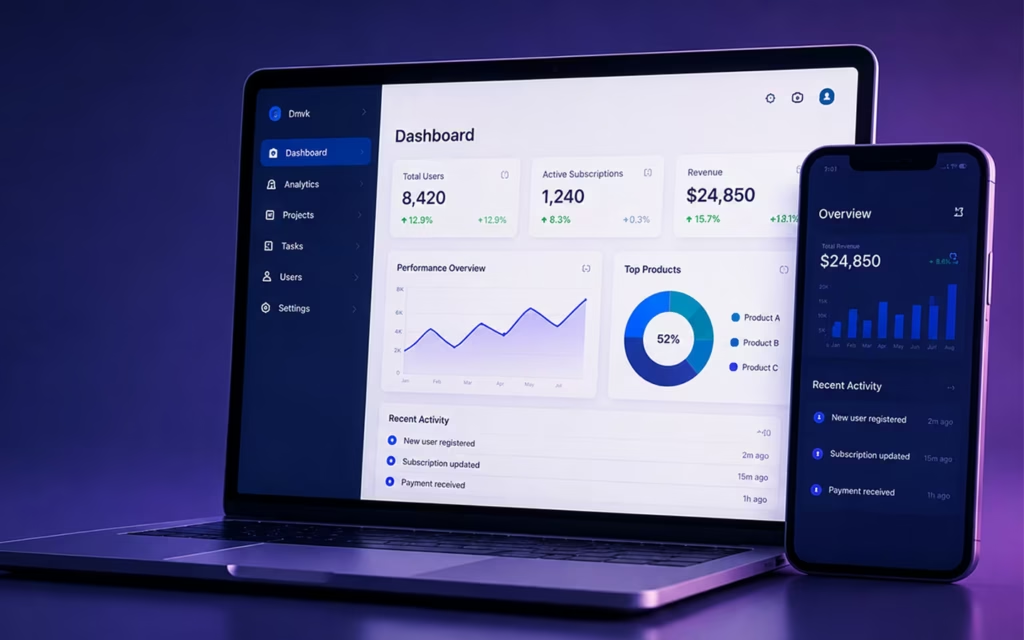
Multi-tenancy is the foundational architecture decision in any SaaS product. Every customer’s data needs to be isolated from every other customer’s data, reliably and by design, not by convention.nWe design multi-tenant architectures that match the security and performance requirements of the product. That might be a shared database with tenant-level row isolation using a tenant ID and appropriate access controls, a schema-per-tenant approach that provides stronger isolation at the cost of more complex database management, or a database-per-tenant model for products where complete isolation is a contractual or regulatory requirement. Each has different trade-offs in terms of operational complexity, cost, and the level of isolation it provides, and we will explain the options clearly so the decision is yours to make with full information.
Subscription billing is more complex than it appears. The happy path, a customer signs up, their card is charged monthly, everything works, is easy. The edge cases are not: failed payments and retry logic, plan upgrades mid-cycle with prorated charges, annual subscriptions with monthly cancellations, free trials that convert (or do not), promotional codes, refunds, and the tax calculation requirements that vary by jurisdiction.nWe build billing infrastructure on Stripe, which handles the payment processing and subscription lifecycle, wrapped in application logic that manages the edge cases correctly and exposes subscription state to the rest of the product in a reliable, consistent way. Customer-facing billing portals, invoice history, and payment method management are all included.
Understanding how users interact with your product is how you make product decisions that improve it. We integrate product analytics that track the events and flows that matter: where users drop off during onboarding, which features drive engagement, what the activation metrics look like for different cohorts, and how usage correlates with retention and expansion revenue.nFeature flags are built into the product architecture to enable controlled rollouts, A/B testing, and the ability to enable or disable features for specific users or customer segments without a code deployment. This is foundational for a product team that wants to ship continuously while managing risk.
Activation rate, the percentage of users who sign up and reach the point where they experience the core value of the product, is one of the most important metrics in early SaaS. It is also one of the most neglected, because the attention during the build is on features rather than the path that gets users to them.nWe design and build onboarding flows that guide new users to activation efficiently: account setup, team invitation, initial configuration, and the first meaningful action in the product. User management covers the full lifecycle: signup, email verification, password recovery, profile management, role assignment within a team, and account deletion with appropriate data handling.
At a certain point, customers want to integrate your product with their own systems and workflows. A public API and webhook infrastructure enables this without requiring custom integration work on your side for every customer request.nWe build RESTful APIs with proper authentication, rate limiting, versioning, and documentation. Webhook systems notify customer systems of events in real time. Both are designed with developer experience in mind, because the quality of the API directly affects whether customers build on top of it.
SaaS businesses that retrofit foundational infrastructure into a product that was not designed for it consistently report the same experience: it is slower, more expensive, and more disruptive than building it correctly at the start would have been.nMulti-tenant isolation added to a single-tenant architecture requires touching data models, access control logic, and often the infrastructure layer simultaneously. Billing rebuilt from scratch is a risk event: every edge case in the existing customer base needs to be migrated correctly or manually handled. Onboarding redesigned after activation problems are already visible is remediation, not design.nThe businesses that scale SaaS products efficiently are the ones that invested in the right foundations early. We build those foundations.
A well-scoped SaaS MVP with multi-tenancy, billing, authentication, core features, and onboarding typically takes ten to sixteen weeks. Products with more complex domain logic or more ambitious initial feature sets take longer. We establish a realistic scope and timeline during the discovery phase and structure the work so you have a working, testable product at regular intervals throughout.
Both. We bring our experience building SaaS products to the scoping conversation, which means we will push back on scope that is too broad for an initial version and flag features that are commonly underestimated in complexity. We will not just build what is on the list without applying judgement to whether the list is right.
It depends on your product’s isolation requirements, your expected customer size, and your cost constraints. We explain the options clearly during the architecture phase and make a recommendation based on your specific situation. Most products start with a shared database and strong logical isolation and move to more expensive models only when customer requirements or compliance obligations demand it.
Yes. We assess your existing tooling during discovery and integrate with what is already in place where it makes sense. If something you are already using is not the right fit for a SaaS product, we will tell you that and explain why.
We design for growth from the start. The architecture, particularly the multi-tenant data model and the infrastructure, is designed to scale beyond the initial user count without a rebuild. If growth is faster than anticipated, we work with you on the capacity planning and architecture evolution needed to support it.
Yes. Rebuilds are common, often because an early product was not built with the SaaS infrastructure it now needs. We audit what exists, establish what can be retained, and plan the rebuild and migration in a way that minimises disruption to existing customers.
If you have a SaaS product idea you are ready to move forward with, or an existing product that needs the foundation it was never given, let’s talk through what it involves.
Schedule an Appointment