
The Challenge
- Monolithic systems, weak foundations, and poor visibility create risk, downtime, and limit scalability.
Enterprise Architecture & Platform Engineering
Designing resilient, scalable enterprise platforms that perform under real-world complexity, growth, and continuous change.
We engineer enterprise platforms for millions of users and large data volumes: microservices, multi-region deployment, SSO and role-based access, with the compliance, security and uptime your operations depend on.
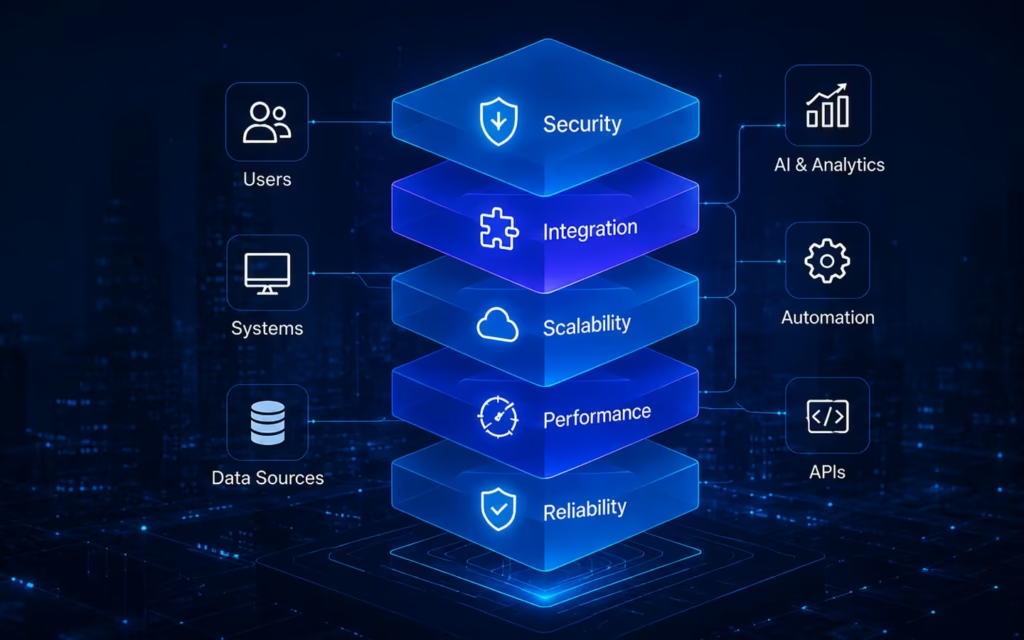
A monolithic application that handles everything becomes a liability at enterprise scale. A change in one area creates risk across the system. Deployments become large and infrequent because everything ships together. Scaling requires scaling the entire application rather than the services under load. The codebase becomes increasingly difficult to change safely as it grows.nWe design and build microservices architectures that decompose complex systems into independently deployable, independently scalable services. Each service owns its domain and its data. Communication between services uses well-defined APIs and, where appropriate, event-driven messaging through Kafka or equivalent platforms. This decouples services from each other, creates a reliable audit trail of system activity, and allows individual components to be updated, scaled, or replaced without affecting the rest of the platform.nThis architecture requires more deliberate design and more operational discipline than a monolith. For platforms that need to grow, change, and remain reliable under real enterprise load, it is the right approach.
Enterprise platforms serve users across time zones and geographies. Data residency requirements, latency considerations, and the need to remain operational when a cloud region experiences problems all drive the requirement for multi-region architecture.nWe design multi-region deployments on AWS, GCP, and Azure that distribute workloads appropriately, handle failover automatically, and keep data in the regions that compliance requires. We design 99.99% uptime as an objective, which means active-active or active-passive infrastructure designed specifically to meet it, not a round number in a proposal. Failover procedures are documented and tested before launch, not assumed to work when they are needed.
Enterprise platforms serve multiple user types with different levels of access to different data and functionality. Access control that is bolted on rather than designed in creates both security risk and operational friction: permissions that are too broad, edge cases that expose data incorrectly, and a system that is difficult to audit.nWe design role-based access control that reflects the actual permission requirements of the organisation and implements them correctly at every layer of the stack, not just at the UI. We integrate with enterprise identity providers through Single Sign-On using SAML 2.0 and OIDC, connecting to Okta, Azure Active Directory, Google Workspace, or the identity infrastructure you already have. Users manage one set of credentials. Access is controlled centrally. Offboarding removes access everywhere.
Regulated industries operate within frameworks that shape how data is stored, accessed, transmitted, and audited. Building to those requirements after the architecture is already set is expensive and usually incomplete. We design with the applicable frameworks in mind from the start.nFor enterprise platforms that typically means SOC 2 Type II for SaaS products with enterprise customers, ISO 27001 for information security management, HIPAA for platforms handling protected health information, and PCI-DSS for systems processing payment data. We document our compliance approach as part of the technical deliverables and build the audit logging, access controls, and data handling procedures that external auditors require to verify compliance.
A platform that cannot be observed cannot be reliably operated. At enterprise scale, issues need to be detected before users report them, diagnosed quickly when they occur, and resolved with clear ownership and accountability.nWe build full observability stacks covering structured logging across services, metrics collection at the infrastructure and application layers, distributed tracing for systems where a single user request crosses multiple services, and alerting configured to signal conditions that require action rather than producing noise that trains teams to ignore it. We work with Datadog, Grafana, Prometheus, the ELK stack, and cloud-native monitoring tools depending on the stack and preferences.nIncident response processes, escalation paths, and runbook documentation are part of every enterprise engagement. When an alert fires, the person responding should know immediately what it means and what to do, not spend time figuring out where to look.
Enterprise platforms that reach scale with a weak foundation tend to reach a point where the cost of the foundation becomes the dominant engineering problem. Performance issues that require rearchitecting the data layer. Security gaps that require a retrofit of access control logic across the entire system. Compliance requirements that require changes to data flows that were not designed with them in mind. Each of these is significantly more expensive to fix in a running production system than to design correctly at the start.nThe organisations that operate enterprise platforms reliably at scale invested in the right decisions early. Not a perfect system from day one, but a foundation designed for the conditions the platform will eventually operate under. That is what we build.
Uptime targets are designed into the architecture rather than stated without a plan behind them. We define the recovery time and recovery point objectives the business requires, design the infrastructure to meet them, test failover procedures before launch, and document them for the team operating the platform. We will tell you during architecture design whether a given target is achievable with the proposed approach and at what infrastructure cost.
Often yes. We audit existing architectures during discovery and assess what can be extended or improved versus what needs to be replaced. We will be direct about what we find. We do not recommend a rebuild when incremental improvement is the right answer, and we do not recommend incremental improvement when it is not.
Data residency is addressed in the architecture design. We identify the jurisdictions involved, the applicable requirements for each, and design storage and processing to keep data in the required regions. This is particularly relevant for organisations operating across the EU and US simultaneously.
The timeline depends on scope and complexity. An initial phase covering core platform functionality and foundational architecture typically takes four to six months. Subsequent phases extend the platform incrementally. We establish a realistic roadmap during discovery and structure delivery so that usable software is produced at the end of each phase.
We build the technical controls required by the applicable framework: access control, encryption, audit logging, incident response procedures, and the documentation that auditors review. For SOC 2 and ISO 27001 engagements, we work alongside your compliance team or third-party auditor and deliver the technical evidence the audit requires, not a verbal assurance that controls are in place.
Sometimes. We audit the current system, identify the specific bottlenecks, and assess whether targeted improvements can address them or whether the underlying architecture makes a rebuild the more practical path. We will give you an honest assessment rather than a recommendation shaped by what is more profitable for us to deliver.
If you are building a platform that needs to operate reliably at enterprise scale, or if your current architecture is struggling under the load it was not designed for, let’s talk through what the right approach looks like.
Schedule an Appointment on our calendar